
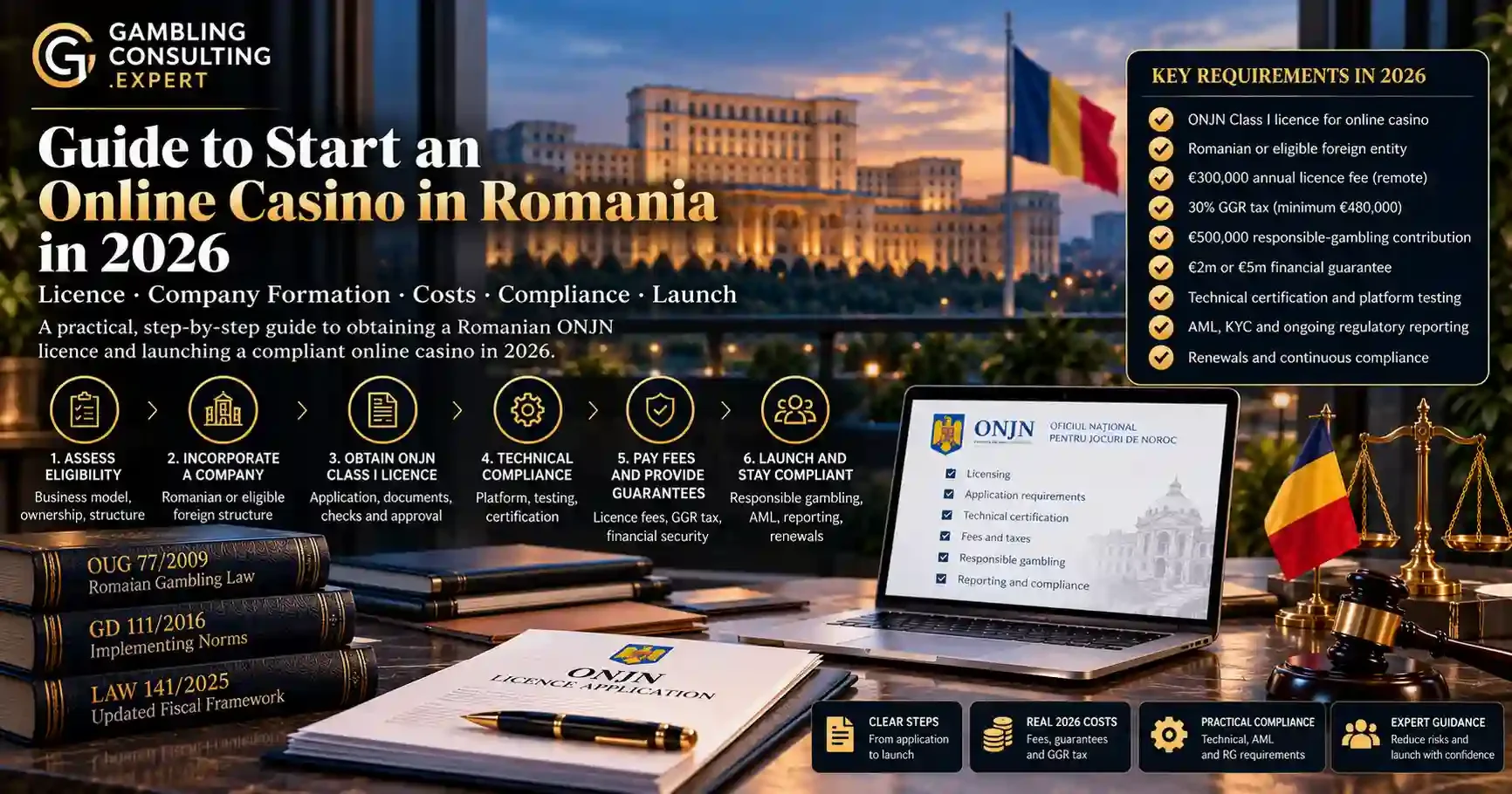
A practical guide to company formation, ONJN Class I licensing, financial guarantees, platform requirements and lawful launch.
Can you legally launch an online casino in Romania in 2026? Yes. Romania permits online casino operations under the licensing and authorization framework administered by the National Gambling Office (ONJN). An operator must satisfy the corporate eligibility conditions, obtain the appropriate Class I license and operating authorization, establish the required financial guarantees, and meet technical, anti-money laundering and player-protection obligations.
However, Romania is no longer a low-cost licensing jurisdiction.
Following the legislative changes effective in 2025, the annual authorization tax for remote gambling is 30% of the relevant gaming revenue, subject to a minimum of €480,000 (Law No. 141/2025). A company offering online casino games must also provide a €5 million financial guarantee, separate from its licensing fees and other commercial expenditure.
A Romanian online casino project therefore needs financial planning before incorporation, platform integration or the signing of major supplier contracts. This guide explains the essential steps — see also our overview of Romania ONJN gambling licensing requirements.
Romania online casino license: key facts in 2026
| Requirement | Position in 2026 |
|---|---|
| Regulator | National Gambling Office — ONJN |
| Relevant operator license | Class I — B2C |
| Standard license validity | 10 years |
| Operating authorization | Required separately for the relevant gambling activity |
| Annual remote Class I license fee | €300,000 |
| Annual authorization tax | 30% of gaming revenue, minimum €480,000 |
| Annual responsible-gambling contribution | €500,000 |
| Financial guarantee for online casino | €5,000,000 |
| Minimum recurring statutory baseline | €1,280,000 a year |
| One-off charges | €3,500 file analysis and €10,500 license issuance |
| Minimum share capital for remote gambling | RON 1,000,000 |
| Legal framework | OUG 77/2009, GD 111/2016 and subsequent amendments |
The €1.28 million figure combines the annual license fee, the minimum authorization tax and the annual responsible-gambling contribution. It excludes one-off official charges, corporate taxes, technical certification, professional fees and other operating expenditure. The financial guarantee is a distinct security obligation and should not be treated as an additional non-refundable licensing fee.
1. Understand Romania’s online gambling regulatory framework
Romania regulates gambling through Government Emergency Ordinance No. 77/2009 and the implementing rules approved by Government Decision No. 111/2016. The National Gambling Office (ONJN) supervises the licensing and authorization procedures.
Romanian law distinguishes between businesses organizing gambling for players and suppliers providing specified services to those businesses.
Class I: gambling operators
The Class I framework applies to qualifying B2C gambling operators, including companies providing remote casino services directly to players. A Class I license should not be confused with the annual authorization needed to operate the approved gambling activity: both the license and the authorization conditions must be satisfied before lawful operations begin.
Class II: gambling industry suppliers
Certain B2B businesses fall within the Class II regime, including specified software providers, gambling platform businesses, payment-related providers and affiliate operations. A supplier’s Class II license does not give that supplier the right to operate an online casino directly with players. Equally, an online casino operator should verify whether the suppliers it engages need their own Romanian license.
Class III: specific gambling activities
Romanian legislation also provides a separate Class III category for the activities reserved under its statutory framework. For a privately operated online casino project, Class I is the central licensing category.
2. Decide which company will hold the ONJN license
The first structural decision is identifying the legal entity that will apply for the license and contract with players.
Romanian licensing rules permit specific corporate structures. A Class I license may be held by a Romanian legal entity, or by an entity established in the EU, EEA or Switzerland operating through a Romanian permanent establishment (OUG 77/2009 art. 1(2), as amended by OUG 82/2023). The precise structure must be checked against the law and the applicant’s actual operations.
Romanian company route
A Romanian company may suit a project that intends to maintain local management, employees, banking arrangements or significant operations. The company must meet the applicable registration, capital, ownership and regulatory requirements.
Foreign company route
A qualifying foreign operator may use an alternative structure, but it cannot simply rely on a foreign certificate of incorporation. The Romanian permanent-establishment requirements, representation, taxation and regulatory documentation must all be examined.
Why this matters
The structure chosen at the start affects:
- Licensing eligibility;
- Ownership and suitability checks;
- Bank and payment-provider onboarding;
- Corporate income taxation;
- Player-contract documentation;
- Technical supplier agreements;
- Regulatory notifications and reporting.
Changing the applicant halfway through the project can lead to substantial rework. Select the legal entity before committing to non-refundable technology or marketing expenditure — our company formation and corporate structuring service covers this step.
3. Meet the capital and financial guarantee requirements
Romanian online casino regulation imposes requirements that must be distinguished from ordinary company-registration costs.
Capital requirements
The sector-specific share capital requirement for remote gambling is RON 1 million (OUG 77/2009, Annex), applied per activity. This is separate from the ordinary minimum capital applicable under general Romanian company law.
Online casino financial guarantee
For online casino activities, the statutory financial guarantee reached €5 million from 1 January 2025 (OUG 77/2009 art. 29). Its purpose is to secure specified payment obligations under the legal framework.
A guarantee is not automatically a payment permanently transferred to the state. Depending on the permitted instrument and the financial institution involved, obtaining it may require collateral, credit facilities, fees or other commitments — which can materially affect the capital needed to launch.
Casino versus other remote gambling products
The online casino guarantee should not automatically be applied to every remote gambling product: betting, poker and bingo carry a €2 million guarantee. An operator intending to offer casino games and additional products needs a specific assessment of the categories and the combined obligations.
4. Calculate the real cost of launching an online casino
Romania’s 2025 amendments significantly increased the financial burden of remote gambling authorization. For a qualifying Class I remote operator, the recurring amounts include:
| Annual obligation | Amount |
|---|---|
| Class I remote license | €300,000 |
| Operating authorization | 30% of relevant gaming revenue, minimum €480,000 |
| Responsible-gambling contribution | €500,000 |
| Combined annual minimum | €1,280,000 |
The statutory amounts above are not the entire project budget. Additional expenses may include:
- One-off application and license issuance charges;
- Company formation and legal work;
- Financial guarantee arrangement fees and collateral;
- Platform licensing and integration;
- Games and content agreements;
- Technical certification and audits;
- AML and KYC systems;
- Payment processing and banking;
- Staffing and customer support;
- Advertising and affiliate management;
- Corporate taxation and accounting.
How does the 30% authorization tax work?
The tax is calculated on the statutory definition of revenue from gambling, not on total player deposits.
As a simplified illustration: if relevant annual gaming revenue is €2 million, a 30% charge produces €600,000, which exceeds the €480,000 minimum. Total recurring obligations in this example rise from the €1.28 million minimum to €1.4 million, before other taxes and costs. The minimum applies until gaming revenue passes €1.6 million (€480,000 ÷ 30%).
These figures are illustrative and must be checked against the applicable calculation and payment rules. A financial model built only on the statutory minimum may materially underestimate the tax burden of a successful operator.
5. Prepare the corporate and regulatory documentation
An ONJN application involves more than completing a standard form. The regulator must be able to assess the applicant’s legal status, suitability, financial capacity and proposed operating model.
The dossier may include:
- Company incorporation and constitutional documents;
- Shareholder and beneficial ownership information;
- Details of directors and relevant key persons;
- Integrity and tax-status documentation;
- Financial plans and evidence of capital;
- Source-of-funds documentation;
- Business plan and gambling-product description;
- Technical infrastructure details;
- Supplier contracts and licensing information;
- AML and responsible-gambling procedures;
- Applicable certifications and audit materials;
- Evidence relating to the required financial guarantees.
The documentation must match the license category and the applicant’s proposed activities. Foreign-language documents may need Romanian translations and other formalities, and inconsistent information about the applicant, ownership, domains or technology can trigger requests for clarification. Our gambling license application services cover dossier preparation end to end.
6. Select a compliant casino platform and game suppliers
Technology procurement should start from regulatory requirements, not from the attractiveness of a software catalogue. The platform must suit the products to be offered and support the controls required by Romanian law.
Core requirements
The technical infrastructure may need to support:
- Registration and identity verification;
- Age restrictions;
- Player account management;
- Transaction histories;
- Responsible gambling controls;
- Anti-money laundering monitoring;
- Regulatory data retention and reporting;
- Secure handling of personal information;
- Technical system testing and certification;
- Integration with appropriately licensed suppliers.
Games, random number generators and platform components may require testing and certification. A white-label commercial arrangement does not automatically transfer regulatory responsibility from the operator to the technology provider: the parties must identify who contracts with players, who controls the platform, who handles payment flows and who is responsible for compliance.
Verify suppliers before integration
Review the contracting entity, its license status, technical certifications and its ability to maintain continuing service. Romania’s amended framework also restricts the provision of certain regulated B2B services to unauthorized gambling operators, so a supplier arrangement that looks commercially attractive can create serious risk if the licensed entities, domains and markets are inconsistent.
7. Establish payment processing and banking arrangements
Payment processing is central to any online casino project. Operators must assess the regulatory status of payment providers, the permitted flow of player funds, transaction monitoring and the applicable anti-money laundering requirements. A payment provider’s familiarity with gambling does not mean every payment method is permitted in every jurisdiction.
What about cryptocurrency?
Cryptocurrency should not be listed as an automatically acceptable deposit or withdrawal option. Any proposed crypto-related payment arrangement must be reviewed against Romanian gambling rules, AML obligations, payment-services regulation, banking acceptance and other applicable restrictions. Using cryptocurrency does not change the licensing obligations attached to gambling activities.
What should a banking dossier contain?
Banks and payment providers may request:
- Incorporation and ownership records;
- Details of the ONJN application or license;
- Identification of directors and beneficial owners;
- Business plans and financial forecasts;
- Supplier and customer relationships;
- AML/KYC procedures;
- Source-of-funds evidence;
- Expected transaction flows.
Plan payment arrangements before launch, but do not activate services that depend on an effective license prematurely. See our gaming banking and payment preparation service.
8. Implement responsible gambling and player-protection measures
Player protection must be built into the operating model before the casino launches. Requirements may involve:
- Age and identity verification;
- Protection against access by minors;
- Responsible gambling information;
- Deposit limits and other player controls;
- Self-exclusion and account restrictions;
- Monitoring of gambling-related harm indicators;
- Customer communication and complaint procedures;
- Appropriate employee training.
The exact functionality and procedures must satisfy the Romanian requirements for the licensed product. A generic responsible gambling policy does not demonstrate compliance if the platform cannot implement the safeguards it promises.
Financial commitment to responsible gambling
The Class I remote-gambling framework includes an annual responsible-gambling contribution of €500,000. This financial obligation is separate from the duty to implement practical protection measures: paying the contribution does not replace operational responsibility toward customers.
9. Prepare AML, KYC and fraud-prevention controls
Online gambling involves financial transactions and is subject to anti-money laundering and counter-terrorist financing requirements. The operator must establish risk-based procedures appropriate to its activities, including customer due diligence, transaction monitoring, identification of suspicious patterns, reporting duties, recordkeeping and governance.
These requirements should be assessed together with Romanian AML law, including Law No. 129/2019, and sector-specific rules. Technology can support verification and monitoring, but accountability remains with the legal entity and its designated responsible persons. Operators should also have internal procedures for payment fraud, account takeover and other security incidents.
10. Obtain the ONJN license and operating authorization
Organize the application around a documented project plan.
Step 1 — Regulatory eligibility review. Confirm the products, applicant entity, ownership structure, capital requirements and suitability criteria.
Step 2 — Financial and technical feasibility. Verify the statutory obligations, guarantee arrangements, technology, suppliers and projected operating costs.
Step 3 — Corporate preparation. Complete incorporation or the eligible foreign-entity arrangements and prepare ownership records.
Step 4 — Application dossier. Assemble and verify the legal, financial, technical and compliance documentation.
Step 5 — ONJN review. Submit the application and respond to any regulator requests for information or clarification.
Step 6 — Authorization and launch readiness. Complete every condition for the license and the operating authorization, including payments, certifications and operational controls.
The casino must not accept wagers from Romanian players until all applicable permissions are in force. A pending application or a service-provider agreement is not a substitute for the operator’s own authorization.
11. How long does it take to launch an online casino in Romania?
There is no dependable universal timeframe for every Class I project. The schedule depends on corporate eligibility, ownership complexity, document availability, financial guarantee arrangements, technical certification and regulatory review. For planning purposes, expect several months from initial structuring to a legally authorized commercial launch.
Treat the licensing decision and the commercial go-live date as separate milestones. Some preparatory work can run in parallel — platform integration planning, compliance documentation and banking due diligence — but no activity requiring an effective license may start before authorization is granted. A good project schedule identifies the critical path and the responsibilities of legal advisers, technical suppliers, testing laboratories and management.
12. Understand advertising and affiliate requirements
Online gambling advertising in Romania is regulated. Operators must examine the restrictions on marketing content, targeting, minors, promotional materials and approved gambling activities. Affiliate businesses may themselves fall within the Class II regime, but a marketing partner’s own compliance duties do not remove the Class I operator’s responsibilities.
Before launching a campaign, verify:
- The licensed legal entity and approved domains;
- The legal status of the marketing supplier;
- Compliance of the advertising content;
- Location and age targeting;
- Bonus terms and customer disclosures;
- Data-protection and tracking requirements.
Marketing must not direct Romanian consumers to gambling products or domains that are not properly authorized.
13. Continuing compliance after launch
Obtaining the license is not the end of regulatory supervision. A Romanian online casino should maintain a continuing compliance program covering:
- Annual licensing payments and operating authorization obligations;
- Financial guarantee maintenance;
- Technical certification and systems changes;
- AML and player-protection controls;
- Regulatory reporting;
- Supplier due diligence;
- Advertising and affiliate compliance;
- Data protection and information security;
- Changes in ownership, management or products;
- Regulatory enquiries and incidents.
Assess material changes before implementing them — introducing a new gaming product or changing a core platform provider may require additional legal, regulatory or technical review. A twelve-month compliance calendar should list each recurring obligation, the responsible person, the deadline and the supporting evidence.
14. Can a Romanian casino license be used across Europe?
No. Romanian authorization grants the rights provided under the Romanian licensing framework; it is not a European gambling passport. An operator intending to serve consumers in Great Britain, Germany, the Netherlands or other regulated markets must assess each market’s local licensing rules.
Similarly, an offshore license issued in Curaçao or Anjouan cannot replace Romanian authorization where Romanian law requires it. The target markets should determine the licensing and corporate strategy — compare options in our jurisdiction guides.
15. Is starting an online casino in Romania worth it in 2026?
Romania has an established regulated gambling framework and a developed ecosystem of technology suppliers, payment businesses and gaming professionals. However, entry costs and ongoing obligations are significant.
The commercial decision should rest on realistic customer acquisition costs, retention assumptions, expected gaming revenue, software expenses, licensing payments, taxation and capital availability. A business that can afford incorporation and an initial platform package may still be unable to meet the annual authorization charges or provide the required financial guarantee.
The three questions every investor should answer
- Can the applicant qualify? Confirm ownership, financial capacity and the legal structure.
- Can the platform comply? Establish whether suppliers, technical systems and player-protection controls meet Romanian requirements.
- Can the company sustain the full financial burden? Model government fees, variable charges, guarantee collateral and operating costs under conservative assumptions.
A successful licensing strategy starts with these answers, not with buying a casino website template.
Conclusion: start with regulatory and financial feasibility
Launching an online casino in Romania in 2026 is legally possible, but it requires substantial investment and ongoing regulatory discipline. The central requirements are the ONJN Class I license, the operating authorization, an eligible corporate structure, financial security, technical certification, responsible gambling safeguards and AML compliance.
The recurring statutory minimum of about €1.28 million a year, together with the €5 million online casino guarantee, makes detailed financial preparation essential. Verify the legal and commercial model before committing to irreversible contracts.
The strongest casino launch is not the fastest one. It is the one that is properly licensed, financially sustainable and technically prepared for continuing compliance.
How Gambling Consulting Expert can help
Gambling Consulting Expert provides advisory services for gambling licensing, corporate formation, banking preparation and international market entry. We help businesses assess applicant eligibility, identify the right licensing route, coordinate documentation and organize specialist support for regulatory projects.
If you are considering a Romanian online casino, begin with a structured feasibility review covering the proposed company, products, capital, guarantees, suppliers and ongoing obligations: request an online casino licensing assessment, or write to hello@gamblingconsulting.expert.