
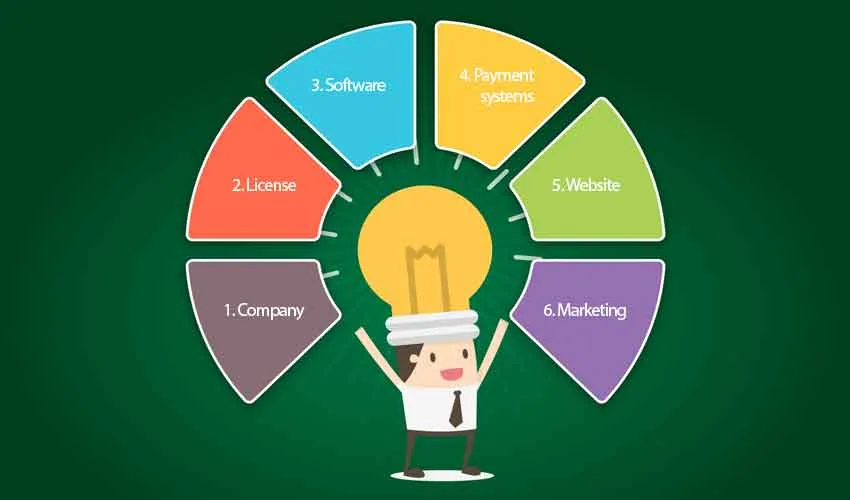
The 2021 version of this guide listed generic steps. Since then, the license landscape has changed: Curaçao replaced its sub-license system in December 2024, Nevis launched a new regulator in 2025, Romania raised its remote gambling tax in 2025 and the UK raised Remote Gaming Duty to 40% in 2026. This update gives a practical 2026 sequence and current costs.
Step 1: Choose your target markets
Everything follows from where your players will be. For each market, check whether online casino is licensed locally, prohibited, or unregulated. Our guide to where online gambling is legal in 2026 is a starting point.
- Regulated markets (UK, Italy, Netherlands, Denmark, Sweden, Romania, Ontario and others) require a local license.
- Prohibited markets (India, Turkey, Australia for casino, Brazil since September 2026) must be blocked.
- Other markets can often be served under an international license, subject to local law.
Step 2: Pick the license
| License | Annual cost (indicative) | Substance | Typical timeline | Guide |
|---|---|---|---|---|
| Nevis | €28,000 flat | Nevis company, registered agent, Reporting Officer | 8–12 weeks | Nevis |
| Curaçao | €47,450 (B2C) | Local company, resident director, office | 2–5 months | Curaçao |
| Kahnawake | US$20,000 + US$35,000 application | MIT hosting | 2–3 months | Kahnawake |
| Isle of Man | £36,750 + duty from 1.5% of GGY | Two resident directors | 10–12 weeks | Isle of Man |
| Malta | €25,000 + compliance contribution | Maltese company, key functions | 4–6 months | Malta |
| Romania | At least €1.28 million in statutory charges | Romanian company or EU branch, €5m guarantee | 6–9 months | Romania |
For a Romanian launch, see our dedicated guide to starting an online casino in Romania.
Step 3: Set up the company and substance
Form the licensed company where the regime requires it, appoint directors and key-function holders who pass fit-and-proper checks, and plan the local substance the regulator expects. Think about where management decisions are really taken, since that affects tax. Our company formation service covers this stage.
Step 4: Platform and games
- Turnkey platform — your own license, a licensed platform provider and your own brand; more control, more work.
- White label — faster launch on a provider’s setup; check who holds the license and whether that works in your markets.
- Games — use studios certified for your jurisdictions; many regulated markets also require B2B supplier licenses (Romania Class II, Sweden, UK).
All systems need RNG and platform certification from an accredited testing lab.
Step 5: Payments and banking
Payment acceptance depends on the license, the markets and your compliance file. Prepare corporate documents, license, AML policies and source-of-funds evidence before approaching banks and payment providers. See our banking preparation service.
Step 6: Compliance
- AML/CFT: risk assessment, KYC, transaction monitoring and suspicious-activity reporting;
- Responsible gambling: limits, self-exclusion (and national registers where they exist), affordability checks where required;
- Marketing: local advertising and bonus rules — several markets ban or restrict both;
- Data protection and technical reporting to the regulator.
Step 7: Launch and scale
Launch in your licensed markets, keep geo-blocking for the rest, and add local licenses as you grow. Budget for working capital: most new casinos need months of marketing spend before reaching break-even.
How Gambling Consulting Expert can help
We start with a market and license feasibility review, then handle company formation, the license application, banking and supplier contracts through to launch. Contact us.